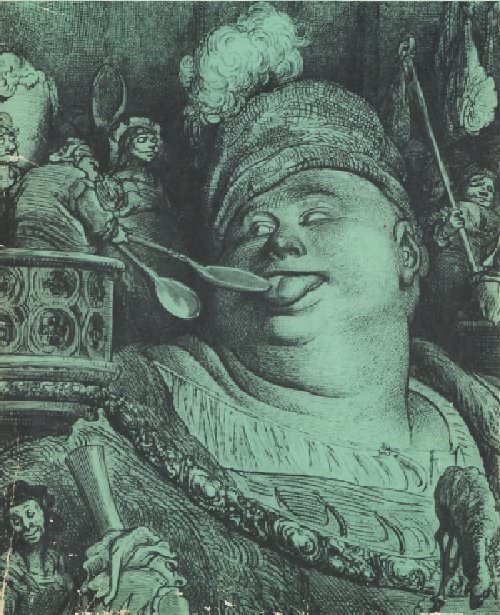
I just finished reading Gargantua by Rabelais. The book, a tirade of filth and giddy absurdities, was written in the 15th century, in the tradition of those great books which came out of Nero’s court, Satyricon and The Golden Ass. Gargantua is the son of a wealthy noble living in the countryside of France. His birth, like his enormous stature, is unusual: he makes his way through his mother’s organs and heads out her ear. Rabelais injects meaning into this preposterous inception by telling of all the ancient tales of ‘immaculate’ conception. So the story lives and breathes on the logic of mythology itself. This is what makes its realism so hard to express.
Gargantua’s size is demonstrated in many sections of the book. Whether it is the fact that when he pees he creates a river which drowns men or that his clothing, described in excess detail, requires yards and yards of string. What is more shocking than this, or what becomes the realistic force of the book, is that not a single character in the book questions the size of Gargantua. They drink with him, they teach him philosophy, they fight alongside him, in some cases they seem to fight as strongly as he does. If this is a world of giants than why even describe Gargantua’s birth and size in such detail? If this is not a world of giants, why, in a book which makes sure to detail intricate movements (like the monk’s theatrical spinnings on his horse), is there no mention of the strain required to interact with Gargantua? His size is completely assimilated into the psyche of all the characters living, as if they all already believe the logic and tradition of the folk tale.
It is not a story about princes and princesses. It is a story of a feudal war, and though the cause for war, the cake-makers have been deprived of their grapes (how French, right?), seems outrageous, it is not a stretch at all to view this trivial uprising as more than allegorical. If an allegory uses metaphors to clarify human actions, to raise them up to a ground of morality, Rabelais uses metaphors to make man realize he is just as ridiculous. Cake is the sustenance of the cake-makers, and stolen grapes--which are necessary for cakes--will cause an uproar. Are wars any different than one group hording the resource another group needs? And are those values of need just as arbitrary? Oil and cars. When Picrochole, the leader of the cake-makers refuses to accept the appeasement of Grandgousier, Gargantua’s father, who supplies Picrochole with more cakes than he could dream of, the story becomes an all out blood bath, including some scenes which remind you of Kung-Fu cinema. The blind fervor for destruction, that the cake-makers want to control lands as far as India and Africa, is all too familiar to the logic of history. These characters think on enormous scales, their consciousness represents a fast-forwarded accumulation of possibility. Death and gore occur as often and with as little care as do farts, belches, vomits and womanizing. And a hearty drink is always passed around.
If Gargantua is the protagonist, it is because he sets the scale of size for the novel. That nobody is surprised by him makes the whole tale a Gargantua. It is Friar John, a brilliant warrior who takes out a whole battalion with his holy staff, upon whom Rabelais gives the burden of an ethos. Friar only by name and dress… he is always contradicting the rules and burdens of the Christian faith in the name of a faith dressed down of all its excesses. Just as Gargantua is superfluously large, Friar John is superfluously Christian. He fights, drinks, and disagrees with all the foolish rules of the monastery. And the ethics of the book comes from the masters, the noblemen, directly refuting the fearful morality of the pilgrims and the devout. By what rite does Friar John do as he please, by what rite does he drink in the middle of the night, “According to the rite of When-and-where: with three psalms and three lessons, or with nothing at all for those who want nothing. I never subject myself to hours; hours were made for man, and not man for hours. Therefore I make mine in the fashion of stirrup-leathers. I shorten them or lengthen them when I see fit.” The holy man defines his own holiness. Is not the reversal of hours similar to Nietzsche’s question: “Is man god’s biggest mistake, or is god man’s biggest mistake?”
It is no surprise that the Gargantua ends with a rethinking of debt and credit.
Having conquered the cake-makers, Gargantua gives a long speech where he states that instead of erecting architecture on the conquered lands he will build monuments, this way, by indebting the captured people with gratitude, they will not only pay the demands of their rulers, they will willfully pay interest year after year, for it is only resentment which causes stinginess. The new mode indenture is to allow the slave to feel the prosperous lenity of the happy master. Thus Gargantua and his tribe live in a richly described exuberant excess. An abbey is built, but it has no walls, and there is only one rule: Do What You Will. The book ends like a fairy tale, and its happy ending is the erasure of Christian dogma. A long prophecy concludes the book… it is the tale of the floods and the kingdom come, it is considered a riddle. The riddle is solved by comparing the prophecy to a game of tennis. The Friar advises, “You can read all the allegorical and serious meanings into it that you like, and dream on about it, you and all the world, as much as ever you will. For my part, I don’t think there is any other sense concealed in it than the description of a game of tennis wrapped up in strange language. The suborners of men are those who make up the matches, who are usually friends; and after two sets are played, the one who was serving goes out of play and the other comes in. People belive the first man who says whether the ball passed over or under the cord. The waters are the sweat; the racket strings are made of the guts of sheep or goats; the round machine is the pellet or tennis-ball. After the game they refresh themselves before a clear fire and change their shirts, and they are glad to feast, but gladdest of all are the winners. And here’s good cheer!” The round-machine, the ball, is a reference to the world itself. In Gargantua, the winners don’t sit constrained to the world, they play with it. The masters are those who master the world by seeing outside of it, and so they are enormous, cloaked in the finest dress, and free to barf, drink and pillage the towns of the resentful.
The world of Rabelais achieves comedic subversion of convention. The sacred is no longer restraint, for restraint itself is the embarrassing obstacle of existence, which is merely the humor of the body and the exertion of selfhood untrammeled by law.